

Posted by Jamie Sinclair
on November 01, 2026

To keep your dog calm on New Year's Eve, start preparing in early December. Play quiet firework sounds daily, build a cosy den, and start calming support by mid-December. On the night, walk and feed early, close curtains, and stay home with your dog through midnight, when fireworks go off across the UK at once.
New Year's Eve is different from Bonfire Night. The bangs come late, all at once, often after a busy evening of guests. This guide gives you a week-by-week countdown, and explains why our Calming Treats work best when you start them around 17 December, not on the day.
Last updated 1 November 2026. Written by Jamie Sinclair, who writes about canine health, nutrition, and everyday care for Doggy Dailies, focused on translating veterinary research and real ingredient science into practical, honest guidance UK dog owners can use. Products vet-formulated with input from Lourdes María Arnedo Amat, veterinary graduate.
Table of Contents
- How Common Is Fear of Fireworks in UK Dogs?
- Why Is New Year's Eve So Hard for Dogs?
- Signs Your Dog Is Scared of Fireworks
- Your New Year's Eve Countdown Plan
- How Do You Set Up a Fireworks Den?
- Sound Therapy: Teaching Your Dog Bangs Are Boring
- How to Calm a Dog During Fireworks at Midnight
- Calming Treats: Why Mid-December Matters
- What Not to Do on New Year's Eve
- When Should You Talk to Your Vet About Medication?
- FAQ
- Sources
How Common Is Fear of Fireworks in UK Dogs?
If your dog dreads fireworks, you're in very big company. UK charities and researchers have measured it again and again, and the numbers are striking.
| Source (year) | What they found |
|---|---|
| Dogs Trust National Dog Survey (reported October 2026) | Almost one in three (29%) UK dog owners say their dog has shown sound sensitivity to fireworks in the past 12 months |
| Dogs Trust National Dog Survey (2024) | 26% of owners said their dog rarely stayed calm when hearing fireworks |
| Royal Kennel Club (2024) | 40% of owners say their dog is scared of fireworks, and 13% say their dog has tried to flee |
| Royal Kennel Club Petlog data (2023) | 81% more dogs were reported missing from 30 October to 13 November 2023 than in the two weeks before |
| PDSA PAW Report (2020) | 22% of UK dog owners say their dog is afraid of fireworks, around 2.2 million dogs |
| PDSA PAW Report (2020) | 61% of vets had seen more pets with phobias, including fireworks, over the previous two years |
| PDSA PAW Report (2019) | 40% of dogs, around 3.6 million, are afraid of fireworks |
| RSPCA (campaign page) | An estimated 62% of dogs show signs of distress during fireworks |
| University of Bristol (Blackwell et al., 2013) | Almost half of owners saw at least one fear sign when their dog heard loud noises, and fireworks caused the most fear responses |
Sources: Dogs Trust and University of Salford (2026), Dogs Trust, Royal Kennel Club, PDSA, PDSA New Year's Eve advice, RSPCA, University of Bristol.
The Bristol study also found that fewer than a third of owners of noise-fearful dogs asked for professional help. Many dogs simply struggle through every year.
Escape is a real risk too. The Royal Kennel Club's Petlog figures show missing-dog reports jump during firework season, so check your dog's microchip details as the first step in your countdown.
Why Is New Year's Eve So Hard for Dogs?
If you've read our guide to preparing your dog for Bonfire Night, much of it still applies. But New Year's Eve brings its own challenges.
- Midnight, all at once: on Bonfire Night, fireworks drift across several evenings. At midnight on 31 December, displays start in almost every town at the same moment, so there's nowhere quiet to escape to.
- Later and longer: in England and Wales, fireworks must normally stop by 11pm, but on New Year's Eve the cut-off is 1am (GOV.UK).
- Hogmanay in Scotland: Scottish rules also allow private fireworks until 1am on New Year's Eve, and Hogmanay celebrations often mean bangs on the nights either side (Scottish Government).
- Parties and guests: doorbells, open doors, loud music and party food all add stress and escape risks.
- Late-night walks: a last toilet trip near midnight can mean walking straight into a display.
Signs Your Dog Is Scared of Fireworks
Some fear signs are obvious. Others are easy to miss, especially in a busy house. Dogs Trust lists subtle signs such as panting, hiding or seeking attention, alongside clearer ones such as pacing, barking or toileting indoors.
- Early or subtle: lip licking, yawning, ears pinned back, tail tucked, panting when it isn't warm, sticking close to you.
- Clearer distress: trembling, pacing, whining or barking, drooling, hiding, refusing food.
- Severe fear: trying to escape, digging at doors, toileting indoors, freezing, or chewing through things.
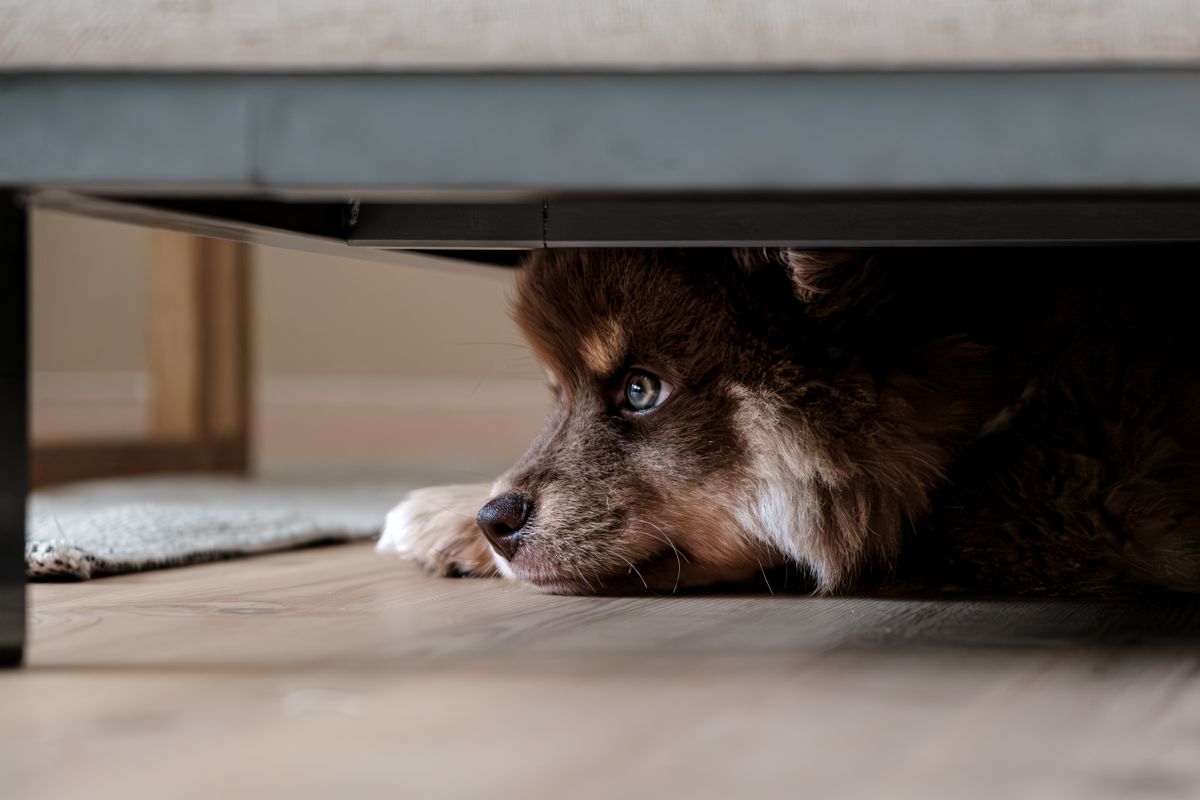
The Bristol researchers noted that quieter signs, like reduced activity and drooling, are often under-reported. A dog lying very still behind the sofa may be just as frightened as one that's pacing.
Your New Year's Eve Countdown Plan
New Year's Eve 2026 falls on a Thursday. Here's a simple countdown with real dates, so you can pop reminders in your phone now.
| When | Date (2026) | What to do |
|---|---|---|
| 4 weeks before | Thursday 3 December | Check microchip details and ID tag. Start sound therapy at very low volume. Book a vet chat if your dog's fear was severe last year. |
| 2 weeks before | Thursday 17 December | Start daily calming support. Set up the den so it feels normal before the big night. Check fences and gates for gaps. |
| Week of | 24 to 30 December | Keep sound sessions short and happy. Slowly move dinner and the last walk earlier. Plan who stays home at midnight. |
| The day | Thursday 31 December | Long walk in daylight. Feed before dusk. Close curtains early. Brief guests. Stock the den with chews. |
| At midnight | 11.30pm to 1am | Stay with your dog. Music or TV on. Doors closed. No garden trips until it's quiet. |
| New Year's Day | Friday 1 January | Lead on for walks, as stray bangs continue. Back to normal routine. Note what helped for next year. |
The Dogs Trust advice also says to review afterwards. If your dog was badly shaken, seek professional help well before the next firework season, rather than waiting for next November.
How Do You Set Up a Fireworks Den?
A den is a safe hideaway your dog can choose to use. PDSA suggests a quiet room or cupboard, set up in advance so your dog already sees it as safe.
- Pick the quietest spot: an inner room, under the stairs, or a crate away from windows and the party.
- Muffle it: drape a thick blanket over a crate, leaving the door open, and add cushions to soak up sound.
- Make it smell like home: add their bed and an unwashed jumper of yours.
- Add something to do: a long-lasting chew or a stuffed toy gives them a calming job.
- Never shut them in: a trapped, frightened dog can panic and hurt themselves.
Sound Therapy: Teaching Your Dog Bangs Are Boring
Desensitisation means playing firework sounds so quietly that your dog barely notices, then very slowly turning them up while good things happen. Over time, the sound starts to predict treats and play, not danger.
Dogs Trust offers a free programme called Sound Therapy for Pets. Its "Sounds Scary" pack, developed by two vets who specialise in behaviour, pairs firework recordings with a step-by-step guide (Dogs Trust).
- Start at a volume where your dog stays relaxed. If they look up or stop eating, it's too loud.
- Keep sessions short, a few minutes a day, during dinner or play.
- If your dog shows stress, stop and go back to a lower volume next time, as PDSA advises.
- Keep going after New Year, so the progress carries into next year.
Four weeks is a realistic minimum to see progress. Some dogs need months, so if your dog struggles badly, use this year as the start of a longer plan.
How to Calm a Dog During Fireworks at Midnight
The last hour of the year is the main event. Here's how to get through it calmly.
- Do the last toilet trip by 11pm. Keep your dog on a lead, even in the garden, in case early fireworks start.
- Brief your guests. Ask them not to feed your dog, to keep the front door shut, and to leave the den alone.
- Keep festive food out of reach. Party snacks often hide grapes, chocolate and onions. Our guide to what dogs can eat at Christmas covers the risky ones.
- Turn up the background noise. Steady music or the TV helps mask bangs. PDSA suggests a playlist with a steady beat.
- Stay close and comfort them if they ask. Comforting a scared dog won't make them more fearful. Speak softly and stay calm yourself.
If your dog usually struggles when left alone, never leave them home alone on New Year's Eve. Fireworks can make separation anxiety much worse.
Calming Treats: Why Mid-December Matters

Doggy Dailies Calming Treats are vet-formulated, duck-flavoured soft chews made to support relaxed behaviour during stressful times. They work best with daily use for 1–2 weeks before an event, so start them around 17 December.
- What's inside (per 2 chews): chamomile 80mg, thiamine 100mg, valerian root 60mg, passionflower 45mg, magnesium 40mg, L-theanine 30mg, L-tryptophan 25mg and ginger root 10mg.
- How many chews: up to about 12kg, 1 chew; 12–23kg, 2 chews; 23–45kg, 4 chews; over 45kg, 6 chews a day.
- What we love: no artificial flavouring or preservatives, and a taste most dogs treat as a reward.
- Best for: dogs who get unsettled by fireworks, visitors and festive change, alongside the plan above.
Calming chews aren't a sedative or a quick fix for severe fear. They're one part of a plan that includes a den and sound therapy. For a wider look at what's out there, read our guides to natural remedies for anxiety in dogs and Adaptil vs Pet Remedy vs calming treats.
What Not to Do on New Year's Eve
- Don't punish fear. Accidents or barking are panic, not naughtiness, and PDSA warns never to punish a frightened pet.
- Don't drag them out of hiding. Let them choose the den, the bed, or behind the sofa.
- Don't take them to a display. Even calm dogs can panic at close range.
- Don't start anything new on the day. New wraps, diffusers or chews work best when your dog is used to them first.
- Don't open the door to first-footers without a plan. Pop your dog in a closed room first, so they can't bolt.
When Should You Talk to Your Vet About Medication?
Book an appointment by early December if your dog trembled for hours last year, tried to escape, hurt themselves, or took days to recover. Dogs Trust notes that vets may prescribe medication, which can also stop fear getting worse over time.
Your vet will check your dog's health first, as some signs of stress can also point to illness. There are licensed options for noise fear, and some need starting well before the night. Our Bonfire Night guide explains one licensed gel in more detail.
Ask about a referral to an accredited behaviourist too. For deep-rooted fear, a long-term behaviour plan makes the biggest difference.
FAQ
When should I start preparing my dog for New Year's Eve fireworks?
Start around four weeks before, in early December. That gives time for sound therapy, a familiar den and a vet chat. Start calming chews around 17 December, as they work best after 1–2 weeks of daily use.
What time do fireworks stop on New Year's Eve in the UK?
In England and Wales, fireworks can legally be set off until 1am on New Year's Eve, instead of the usual 11pm. Scotland also has a 1am cut-off on New Year's Eve, and Hogmanay fireworks often spill over into the nights either side.
How can I calm my dog during fireworks?
Close curtains, play steady music or the TV, and let your dog use a quiet den. Offer a long-lasting chew, stay calm and close, and comfort them if they come to you.
Is it OK to comfort a dog scared of fireworks?
Yes. Comforting a frightened dog won't make them more scared. Speak softly, stay close if they want you, and let them hide if they prefer.
Should I leave my dog alone on New Year's Eve?
Ideally, no. A frightened dog left alone may panic, hurt themselves or try to escape. Plan for someone your dog trusts to stay with them through midnight.
Do calming treats work on the night?
Our Calming Treats are designed for daily use and take 1–2 weeks to show results, so giving them only on the night is unlikely to help much. Start them in mid-December alongside sound therapy and a den.
Sources
- University of Salford (26 October 2026). Dogs Trust and University of Salford launch free calming Sound Blanket (Dogs Trust National Dog Survey figure).
- Dogs Trust: Fireworks appeal (2024 National Dog Survey figures).
- Royal Kennel Club (27 October 2024). Fireworks season sees 81% increase in dogs going missing.
- PDSA (2019). Over 7 million UK pets suffer fireworks terror.
- PDSA (2020). Over 2 million UK dogs suffer firework terror. PAW Report 2020 figures.
- PDSA (2021). Firework fear: preparing pets for New Year's Eve.
- RSPCA Political Animal: Fireworks
- University of Bristol (2013). Blackwell EJ, Bradshaw JWS, Casey RA. Fear responses to noises in domestic dogs. Applied Animal Behaviour Science.
- Dogs Trust: Sound therapy and firework training
- Sussex Express (2022). Dogs Trust New Year's Eve fireworks advice.
- GOV.UK: Fireworks, the law
- Scottish Government: Fireworks - the law
This article is for general information only and isn't a substitute for veterinary advice. Calming Treats are a food supplement, not a medicine, and aren't intended to diagnose or treat any condition. If your dog's fear of fireworks is severe, speak to your vet or an accredited behaviourist.
Make this the calmest New Year yet! Pop 17 December in your diary, grab your Calming Treats with free UK delivery, and start your countdown plan today. Your dog will thank you at midnight.
