

Posted by Jamie Sinclair
on October 03, 2026

Dental disease affects an estimated 12.5% of UK dogs every year. It progresses through distinct stages, from reversible gingivitis to advanced periodontitis and tooth loss.
Left untreated, its bacteria can enter the bloodstream, and research links this to strain on the heart and kidneys too. This guide covers how it progresses, what to watch for, the real evidence on systemic risk, and what professional treatment involves.
Written by Jamie Sinclair, who writes about canine health, nutrition, and everyday care for Doggy Dailies — focused on translating veterinary research and real ingredient science into practical, honest guidance UK dog owners can use.
Last updated: 3 October 2026

Table of Contents
- What Is Periodontal Disease, Exactly?
- How Common Is Dental Disease in Dogs?
- The Stages of Periodontal Disease
- Signs of Dental Disease to Watch For
- Does Breed or Size Make a Difference?
- Beyond the Mouth: The Heart, Kidney & Liver Link
- What Professional Dental Cleaning Actually Involves
- What Home Care Can — and Can't — Do
- FAQ
- Sources
What Is Periodontal Disease, Exactly?
Periodontal disease is a progressive infection of the tissues that hold a tooth in place: the gums, the ligament, and the bone underneath. It starts with plaque, a soft film of bacteria, food particles and saliva proteins that forms on teeth within hours of eating.
Left undisturbed, plaque mineralises into tartar (calculus) within days. Tartar is hard, rough and impossible to remove by brushing alone, and it gives bacteria a permanent foothold against the gumline.
The bacteria then trigger inflammation that, over time, destroys the attachment between tooth and bone. This is periodontal disease, and unlike simple gingivitis, the damage it causes cannot be reversed.
How Common Is Dental Disease in Dogs?
Dental disease is genuinely one of the most widespread health conditions in dogs, not a niche concern. A 2021 VetCompass study covered over 22,000 dogs across 784 UK veterinary clinics. It found that 12.5% of dogs — roughly 1 in 8 — were diagnosed with periodontal disease in a single year (O'Neill et al., 2021, Journal of Small Animal Practice).
That figure is for diagnosed cases in one year alone, using clinical records rather than detailed oral examination. Studies that examine every tooth under anaesthetic consistently find much higher prevalence, since early periodontal changes are easy to miss at a routine, conscious check-up.
Risk also rises steeply with age. Put together, most dogs will develop some degree of periodontal disease over their life if it's never addressed.
The Stages of Periodontal Disease
Vets classify periodontal disease into four stages. Catching it at Stage 1 matters enormously, because it's the only stage that's fully reversible with treatment.
| Stage | What's Happening | Typical Signs | Reversible? |
|---|---|---|---|
| Stage 1: Gingivitis | Plaque irritates the gumline; no attachment loss yet | Red, slightly swollen gums; mild bad breath; may bleed when brushed | Yes, fully reversible with cleaning |
| Stage 2: Early periodontitis | Under 25% attachment loss around the tooth root | Noticeable tartar, gum recession beginning, persistent bad breath | No — damage is permanent, but progression can be slowed |
| Stage 3: Moderate periodontitis | 25–50% attachment loss | Visible gum recession, loose teeth starting, discomfort chewing | No — management only |
| Stage 4: Advanced periodontitis | Over 50% attachment loss | Significant tooth mobility, pus, tooth loss, pain, reluctance to eat | No — extraction often required |
This staging comes from the veterinary dentistry classification described in the Merck Veterinary Manual, which also includes a Stage 0 for perfectly healthy gums with no inflammation at all.
Signs of Dental Disease to Watch For
Dogs are good at hiding mouth pain, so visible signs matter more than whether your dog "seems fine." Watch for:
- Persistent bad breath — not ordinary "dog breath," but a genuinely foul, lingering odour
- Yellow or brown tartar buildup, especially along the gumline of the back teeth
- Red, swollen or bleeding gums, particularly when eating or being touched
- Reluctance to eat hard food, dropping kibble, or chewing only on one side
- Pawing at the face or mouth
- Visible drooling, sometimes blood-tinged
- Loose, discoloured or missing teeth
Any of these are worth a vet check. Dental disease doesn't resolve on its own, and the longer it's left, the more of the staging table above your dog is likely to work through.
Does Breed or Size Make a Difference?
Yes, significantly. The same VetCompass research found that risk is far from evenly spread across the dog population:
- Age: dogs aged 8 and over were over three times more likely to be affected than dogs aged 2–4
- Size: dogs under 15kg were 2.5 times more likely to be affected than dogs weighing 30–40kg
- Breed: Greyhounds (32.2%), King Charles Spaniels (30.1%), Toy Poodles (26.0%), Cavalier King Charles Spaniels (25.3%), Yorkshire Terriers (22.2%) and Border Terriers (22.1%) topped the risk list
Small and toy breeds are especially prone because their teeth are often crowded into a proportionally smaller jaw, leaving less space between teeth for saliva to naturally clear food debris. If your dog falls into any of these higher-risk groups, closer monitoring and a more consistent home routine matter more than they would for an average-risk dog.
Beyond the Mouth: The Heart, Kidney & Liver Link
This is the part of dental disease most owners never hear about. When gum tissue is chronically inflamed and infected, bacteria from the mouth can enter the bloodstream — a process called bacteraemia. Once circulating, researchers have investigated whether this bacterial load and the inflammation it triggers can affect organs well away from the mouth.
A retrospective study published in the Journal of Veterinary Dentistry found a statistically significant association between periodontal disease and cardiac signs in dogs. 50.67% of dogs with periodontal disease showed cardiac signs, compared with 3.28% of dogs without it. The same study found no statistical correlation with kidney or liver disease in that particular sample.
Separately, the Merck Veterinary Manual notes that periodontal disease "has been associated with an increased risk of chronic kidney disease" in the wider literature.
It's important to be precise about what this evidence does and doesn't show. These are associations, not proven causation. The researchers behind the cardiac findings explicitly state that "a specific causal relationship cannot be proven." They also flag their study's small sample size and retrospective design as real limitations.
What the research does support is biological plausibility. Chronic oral bacteraemia and the inflammation it drives are a recognised risk factor worth taking seriously, particularly for conditions like myxomatous mitral valve disease. The exact mechanism and strength of the effect are still being studied.
In practical terms, this doesn't mean a dog with mild tartar is at imminent risk of heart disease. It does mean that treating dental disease as "just a mouth problem" undersells what the veterinary literature is finding. That's one more reason professional treatment at the right stage is worth prioritising rather than postponing.
What Professional Dental Cleaning Actually Involves
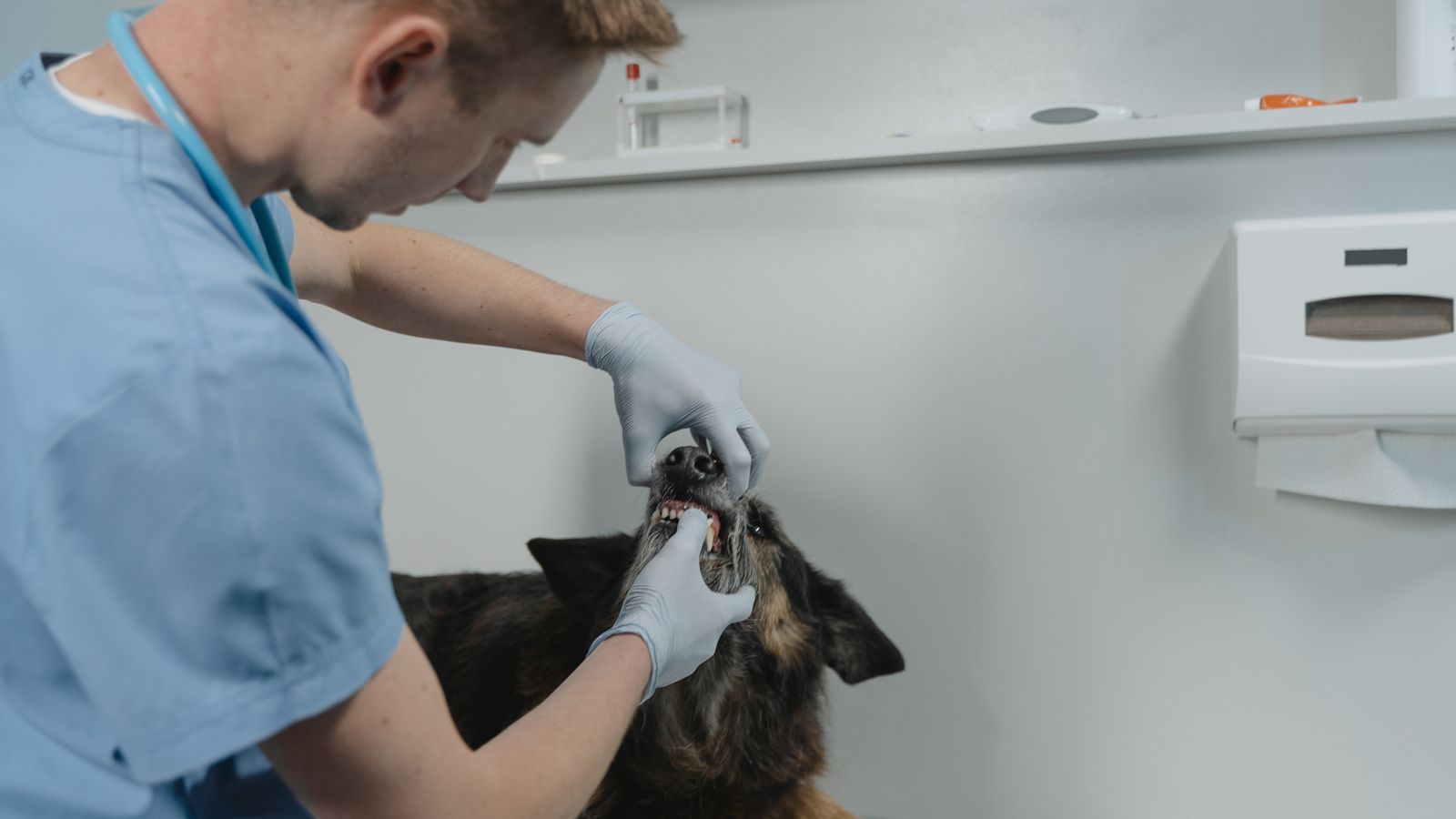
Once tartar has hardened below the gumline, no amount of home brushing can remove it. This requires a professional procedure vets call a COHAT (Comprehensive Oral Health Assessment and Treatment), carried out under general anaesthetic. Here's what that typically involves:
- Pre-anaesthetic blood test. Especially for older dogs, this checks that the liver and kidneys can safely process the anaesthetic — relevant given the systemic links discussed above.
- Full oral examination and dental X-rays while under anaesthetic, checking below the gumline and at the tooth roots for damage invisible to the naked eye during a conscious exam.
- Ultrasonic scaling to remove tartar from above and below the gumline, something that simply isn't possible or safe in a fully conscious dog.
- Polishing the enamel to smooth out micro-scratches left by scaling, which slows how quickly new plaque can stick.
- Extraction of any teeth that are too damaged to save, carried out in the same anaesthetic so your dog only goes through the procedure once.
- Pain relief and, where there's infection, antibiotics as part of recovery.
This is a genuinely more involved procedure than a cosmetic "clean." General anaesthetic, rather than sedation alone, is the only way to safely and thoroughly treat below the gumline, where early periodontitis actually causes its damage.
What Home Care Can — and Can't — Do
Daily brushing is genuinely effective at slowing plaque build-up and can keep Stage 1 gingivitis fully reversible — but it has real limits. Brushing removes soft plaque above the gumline; it cannot remove tartar that has already hardened, and it cannot reach below the gumline where early periodontitis takes hold.
Dental chews and water additives can help support a brushing routine, but none are a substitute for it. None can treat disease that has already progressed past Stage 1.
For the full step-by-step method — how to introduce a toothbrush, which products to use, and what the VOHC seal means — see our complete guide to dog teeth cleaning.
Think of that guide as the practical "how," and this one as the "why it matters." Together they cover the full picture, from daily prevention through to what happens if dental disease is left to progress.
General wellness supplements that support digestion, skin and joint health, like Doggy Dailies' 10-in-1 Multivitamin Chews, are a sensible part of a dog's overall care routine. They aren't a dental treatment, though, and we won't pretend otherwise. If your dog shows any of the signs above, the right next step is a vet dental check, not a supplement.
FAQ
What is the difference between gingivitis and periodontal disease in dogs?
Gingivitis is Stage 1 — gum inflammation with no permanent damage, and it's fully reversible with cleaning. Periodontal disease refers to Stages 2–4, where the attachment between tooth and bone has already been permanently damaged.
How common is dental disease in dogs?
A 2021 UK VetCompass study found 12.5% of dogs were diagnosed with periodontal disease in a single year. Far higher rates are found when dogs are examined fully under anaesthetic rather than at a routine check-up.
Can dental disease in dogs really affect the heart or kidneys?
Research has found a statistical association between periodontal disease and cardiac signs in dogs, and some studies link it to kidney disease risk too. These are associations, not proven causation, but vets take them seriously as a real risk factor.
Can brushing alone treat periodontal disease?
No. Brushing helps prevent and can reverse Stage 1 gingivitis, but it cannot remove hardened tartar or treat disease below the gumline — that needs a professional clean under anaesthetic.
Which dogs are most at risk of periodontal disease?
Older dogs and dogs under 15kg are at significantly higher risk. So are certain breeds, including Greyhounds, King Charles Spaniels, Toy Poodles, Cavalier King Charles Spaniels, Yorkshire Terriers and Border Terriers, per UK VetCompass data.
What happens during a professional dental clean at the vet?
A pre-anaesthetic blood test, full oral exam and X-rays under general anaesthetic, ultrasonic scaling above and below the gumline, polishing, and extraction of any unsaveable teeth, all in one procedure.
Sources
- O'Neill et al. (2021) — Epidemiology of periodontal disease in dogs in the UK primary-care veterinary setting, Journal of Small Animal Practice
- Merck Veterinary Manual — Periodontal Disease in Small Animals
- Royal Veterinary College — Epidemiology of Canine Periodontal Disease
- Clinician's Brief — The Relationship Between Periodontal and Systemic Disease in Dogs
This article is for general information only and isn't a substitute for veterinary advice. If you notice any signs of dental disease in your dog, please book a check-up with your vet.
