

Posted by Jamie Sinclair
on September 05, 2026

Most healthy dogs need bathing every 4 to 12 weeks, depending on coat type, lifestyle and skin condition — short-haired dogs at the lower end, thick double coats at the higher end. Washing more often than that can genuinely disrupt your dog's skin microbiome, according to real veterinary research, so more frequent isn't automatically better. Below, we cover the real guidelines by coat and lifestyle, the science behind over-bathing, when to start with a puppy, how home bathing fits alongside professional grooming, and how to do it safely — including what to actually look for in a shampoo.
Written by Jamie Sinclair, who writes about canine health, nutrition, and everyday care for Doggy Dailies — focused on translating veterinary research and real ingredient science into practical, honest guidance UK dog owners can use.
Table of Contents
- How Often Should You Bathe Your Dog? The Real Guidelines
- Coat Type and Bathing Frequency
- Lifestyle and Activity Level
- Skin Conditions and Allergies
- The Real Risk of Over-Bathing: What the Science Shows
- Bathing Puppies: When to Start and How Often
- How to Bathe Your Dog Safely, Step by Step
- Choosing the Right Shampoo
- Home Bathing vs Professional Grooming
- When to Skip a Bath Altogether
- FAQ
- Sources
How Often Should You Bathe Your Dog? The Real Guidelines
There's no single correct answer to how often you should wash your dog — UK vet charities Blue Cross and the PDSA are both clear that it genuinely depends on your dog's coat, health and lifestyle, not a fixed calendar date. As a general starting point, most healthy dogs with no skin issues do well on a bath every 6 to 12 weeks. That said, the right frequency for your specific dog depends heavily on the three factors below, and bathing is also a useful moment to check your dog over for lumps, parasites or skin changes you might otherwise miss.
Coat Type and Bathing Frequency
Coat type is the single biggest factor. Pedigree UK notes that short-haired and wiry-coated breeds, like most terriers, generally need washing less often than long-haired dogs or those with a thick undercoat, such as a Bernese Mountain Dog. Here's a practical breakdown:
| Coat type | Typical bathing frequency | Example breeds |
|---|---|---|
| Short, smooth coat | Every 8–12 weeks, or as needed | Boxer, Beagle, Staffie |
| Wiry or short double coat | Every 6–10 weeks | Terriers, Corgis |
| Thick double coat | Every 6–8 weeks, with regular brushing between | Golden Retriever, Husky, German Shepherd |
| Curly or wool coat | Every 3–6 weeks, alongside professional grooming | Poodle, Bichon Frise, many doodle crosses |
| Oily-coated breeds | Every 2–4 weeks | Basset Hound, Cocker Spaniel |
Pedigree UK also makes a point worth knowing: the natural oil in your dog's coat isn't just for shine — in water-loving breeds like retrievers, it helps repel water so they dry faster after swimming, and it plays a role in the individual scent dogs use to identify each other. Washing strips this away temporarily, which is one more reason more frequent isn't automatically better.
Lifestyle and Activity Level
An active, outdoorsy dog that swims, rolls in mud, or spends most of the day outside will need washing more often than a dog that's mostly indoors and clean. Blue Cross puts it simply: dogs with a healthy coat and no skin problems really only need bathing when they're genuinely dirty — it's fine to let their natural oils do the work of self-cleaning the rest of the time. If your dog has rolled in something unpleasant or come home caked in mud, that's an obvious wash-now situation regardless of where they'd normally sit on the schedule above.
Skin Conditions and Allergies
Dogs with diagnosed skin conditions are the genuine exception to "less is more." If your dog has an allergy, dermatitis, or a skin infection, your vet may prescribe a specific medicated shampoo and a bathing schedule that's far more frequent than the general guidelines above — sometimes as often as twice a week for a period, tapering off as the condition improves. This is one of the few situations where more frequent washing is genuinely the right call, because it's treating a diagnosed problem rather than routine hygiene. If your dog is scratching, has recurring hot spots, or you're not sure whether it's allergy-related, our guide to why your dog's skin is so itchy covers the common causes in more depth.
The Real Risk of Over-Bathing: What the Science Shows
"Don't overdo it" isn't just folk wisdom — there's genuine research behind it. A controlled study published in Frontiers in Veterinary Science bathed 16 Labrador Retrievers daily for 14 days and tracked their skin bacteria before, during and after. Daily washing measurably disrupted the dogs' normal skin microbiota: the bacteria that are typically most abundant on healthy dog skin dropped in relative abundance, while Staphylococcus — a genus linked to allergic skin disease in other dog studies — increased during the bathing period. The disruption was at its worst after just one week of daily washing, and the skin microbiome still hadn't fully returned to its starting point 35 days after the last bath (Discepolo et al., 2023, Frontiers in Veterinary Science).
This study used daily washing to simulate working-dog decontamination, so it's a more extreme scenario than a typical pet's bathing schedule — but it's genuinely useful evidence for the general principle every UK vet charity repeats: bathing your dog too often strips the natural oils and disrupts the surface bacteria that protect healthy skin, which can lead to dryness, irritation, and a coat that actually looks worse, not better, for all that washing.
Bathing Puppies: When to Start and How Often
Puppy skin is more delicate than an adult dog's, and this is a genuinely under-covered angle in most bathing guides. As a general rule, puppies under 8 weeks old shouldn't be bathed at all — spot-clean with a damp cloth instead if they get dirty. Once a puppy is between 2 and 6 months old, a bath every 4 to 8 weeks is a reasonable starting point, moving to the adult guidelines above once they're fully grown into their adult coat. Always use a shampoo specifically labelled as safe for puppies, since adult dog shampoos and human products can both be too harsh for young, sensitive skin.
How to Bathe Your Dog Safely, Step by Step
- Brush first. Remove loose fur, mats and tangles before they get wet — wet mats are much harder to work through and can trap moisture against the skin.
- Use lukewarm water, never hot, and wet your dog thoroughly from the neck down before shampooing.
- Protect the ears and eyes. Avoid direct water into the ear canal, and use a flannel or your hand to shield the eyes when rinsing the head.
- Use a dog-specific shampoo, massaged in with gentle, circular motions, paying attention to the belly, paws and rear end where dirt and odour build up most.
- Rinse thoroughly. Leftover shampoo residue is a common cause of itchy, irritated skin after a bath, so rinse longer than feels necessary.
- Dry properly. Towel dry, or use a hairdryer on a low heat setting held at least 15–20cm from the body, moving it constantly to avoid overheating one area.
- Make it positive. Blue Cross suggests smearing a little xylitol-free peanut butter on the side of the bath or tub to keep a nervous dog distracted and build a better association with bath time.
Choosing the Right Shampoo
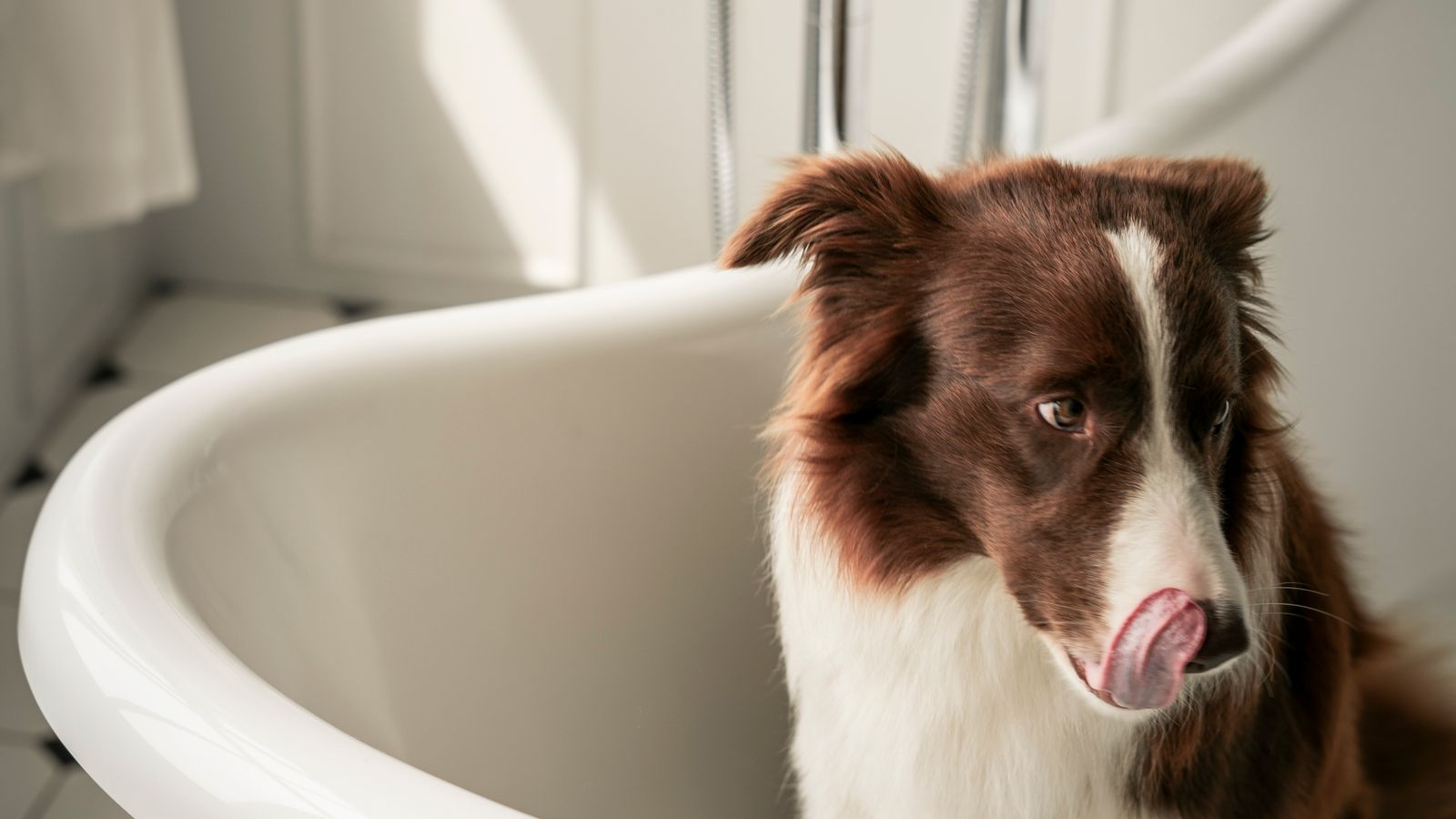
Never use human shampoo on a dog — human skin and dog skin have a different pH, and human products can worsen dryness and irritation rather than help it. Look for a shampoo that's pH-balanced for dogs specifically, free from harsh dyes and parabens, and gentle enough for regular use without stripping the coat. A shampoo with added aloe vera or oatmeal can help soothe dry or sensitive skin, and for dogs with diagnosed skin conditions, always use whatever medicated shampoo your vet has specifically recommended rather than a general product.
Home Bathing vs Professional Grooming
For coat types that need more than a simple wash — curly or wool coats especially — home bathing and professional grooming genuinely work together rather than being alternatives. A full UK grooming session (bath, blow-dry, brush-out, coat trim, and usually nail and ear care) typically costs somewhere between £25 and £80 depending on your dog's size and coat, with curly-coated breeds needing this every 4 to 8 weeks to prevent matting. Home bathing in between professional visits keeps the coat clean without the expense of every wash being a full groom, and it's also the more practical option for breeds that only need an occasional wash rather than a haircut. If cost is a factor, doing your own routine brushing and the occasional bath at home, and reserving the groomer for the coat trim and nail care most owners find harder to do themselves, is a reasonable way to balance the two.
When to Skip a Bath Altogether
There are a few situations where it's best to hold off on bathing, whatever the schedule says:
- After surgery — wait until your vet gives the go-ahead, since early washing can risk infection at the wound site
- Straight after a flea or worming treatment — check the product instructions, since washing too soon can reduce how well a topical treatment works
- If your dog's coat and skin are genuinely clean and healthy — there's no benefit to bathing on a fixed schedule if nothing needs washing off
FAQ
How often should you wash your dog?
Most healthy dogs do well with a bath every 6 to 12 weeks, though this varies by coat type, activity level and skin health. Short, smooth coats can go longer between baths; thick double coats and curly coats generally need washing more often.
Can you bathe a dog too often?
Yes. A controlled study found that daily bathing measurably disrupted the natural skin bacteria on dogs within a week, with effects still present over a month after washing stopped. Over-bathing can also strip natural oils, leading to dry, irritated skin.
How often should you bathe a puppy?
Puppies under 8 weeks shouldn't be bathed at all; spot-clean with a damp cloth instead. From 2 to 6 months, a bath every 4 to 8 weeks is a reasonable guide, moving to adult frequency once they're fully grown.
Can I use human shampoo on my dog?
No. Human shampoo is formulated for a different skin pH and can irritate or dry out a dog's skin. Always use a shampoo specifically made for dogs.
Why does my dog need more frequent baths than other dogs?
Oily-coated breeds, dogs with a diagnosed skin condition, and very active, outdoor dogs typically need washing more often than the general guideline. If your vet has prescribed a medicated shampoo, follow their specific schedule over general advice.
Do I still need a professional groomer if I bathe my dog at home?
For curly or wool-coated breeds, yes, generally. Home bathing keeps the coat clean between visits, but a professional groomer handles the coat trimming and de-matting these breeds need every 4 to 8 weeks.
Sources
- Blue Cross — How often should you wash your dog?
- PEDIGREE® UK — How Often Should You Wash Your Dog?
- Discepolo, Kelley, Watson & Perry (2023) — Impacts to canine dermal microbiota associated with repeated bathing, Frontiers in Veterinary Science
- Dogster — How Much Does Dog Grooming Cost in the UK?
This article is for general information only and isn't a substitute for veterinary advice. If your dog has a skin condition, recent surgery, or you're unsure about the right bathing routine for them, please speak to your vet.
